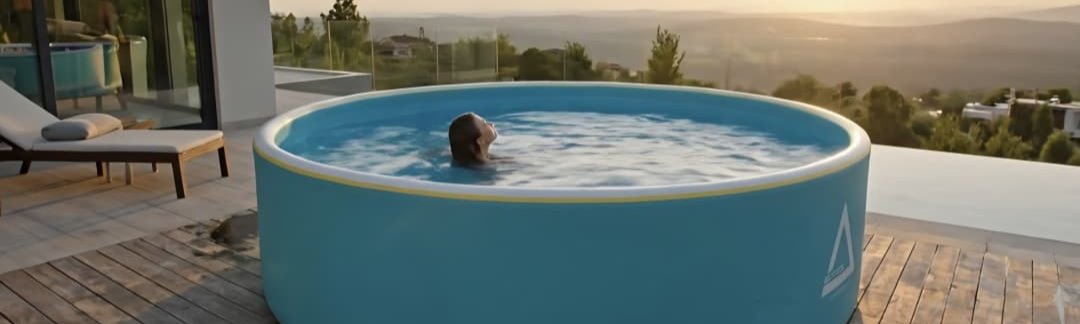
How to prepare a site
for a Drop Stitch pool
Once filled, a full-size swimming pool places a significant load on the surface beneath it, whether the pool uses Drop Stitch technology, a metal frame or permanent construction.
But preparing a site for ISKYPOOL does not mean building a separate concrete foundation when one is not otherwise required.
Level enough.
Clean.
Practical for you.
1. The base must be stable
The main job of the base is to remain stable under the load of the filled pool.
Avoid installing the pool on loose recently placed soil, uncompacted fill or an area that visibly settles under load.
2. How level does the site need to be?
ISKYPOOL does not require you to turn your backyard into a surveying laboratory. The site does not need to be perfectly level to the millimetre.
However, there should be no significant visible slope. The water surface will always remain horizontal. If one side of the pool is noticeably higher than the other, the water level relative to the upper edge will also differ.
If the difference is clearly visible, correct the site before filling the pool.
3. Clean the entire surface
Inspect the complete pool footprint carefully before unfolding the pool.
PVC can be repaired, but the best puncture, somewhat predictably, is the one that never happens.
4. What surfaces can the pool be installed on?
5. What about sand?
Sand is sometimes treated as a universal solution for any uneven pool site. It is not.
A thick layer of loose sand can redistribute and settle under load. ISKYPOOL therefore does not recommend simply placing a loose sand layer over an unsuitable base and assuming the site is now prepared.
6. How much space should you leave around the pool?
There is no universal number.
The space you need depends on the pool size, ladder position, filtration system, heat pump, the layout of your property and the people using the pool.
A Drop Stitch pool has no external supporting legs, so the space around it is primarily needed for people and equipment rather than for a structural metal frame.
Technically, it is possible to design a project in which a Drop Stitch pool is installed below ground level.
However, ISKYPOOL strongly recommends against placing the pool directly against surrounding soil without a separate engineered structure that retains the ground around it.
1. Groundwater and buoyancy
An excavation can collect rainwater or groundwater. When water accumulates outside the pool, it can create upward buoyant force on the structure.
This is not normally a separate issue with a standard above-ground installation because the pool is not sitting inside an excavation that can fill with water. A below-ground project therefore needs its own drainage and groundwater strategy.
2. Soil pressure remains after the pool is drained
While the pool is full, the water inside creates outward pressure against the walls. But pools sometimes need to be drained for cleaning, servicing, repair or seasonal storage.
Once the water is removed, the surrounding soil does not disappear. Heavy wet ground can continue pressing inward against an empty pool wall.
3. Dirt, moisture and restricted access
With a normal above-ground installation, the owner can inspect, wash and dry the exterior of the pool.
Direct burial removes access to much of the outer surface. Moisture, soil and contamination may remain in constant contact with the wall, while inspection and maintenance become more difficult.
4. Soil movement and abrasive wear
Soil is not completely static. It becomes wet and dry, settles and changes through seasonal temperature cycles.
With direct burial, sand, small stones and soil particles can remain pressed against the external PVC surface. Movement between these materials and the pool creates additional mechanical abrasion.
In a normal surface installation, the pool is not permanently surrounded by moving soil.
5. Rodents and hidden damage
Protected spaces below ground can attract rodents and other small animals. An above-ground pool can be inspected around its exterior. After burial, damage may remain hidden because access to the outside wall is restricted.
At that point, you are no longer simply “burying a swimming pool.”
You are creating a separate below-ground space in which the pool is installed. That is an engineering project that needs to be designed for the specific site.
7. Check the site again during the early stage of filling
Even after preparing the site, do not immediately turn on the water and disappear to do something more entertaining.
• whether the pool remains correctly positioned;
• whether there is any obvious tilt;
• whether the base is settling;
• whether any hidden protrusion has become visible under load;
• whether the ladder and equipment locations remain practical.
This is still the easy moment to correct a problem. Once the pool is completely full, it becomes considerably less convenient.
Level enough.
Clean.
Practical for you.